Inside the WaterBotics Curriculum: How It’s Built and What Educators Actually See
The WaterBotics curriculum has been deployed with thousands of middle and high school students across five U.S. geographic regions through National Science Foundation grants funded under awards 0624709 and 0929674. The research base behind it is substantial — eight years of development and study by the Center for Innovation in Engineering and Science Education (CIESE) at Stevens Institute of Technology produced documented findings on what the program teaches, who it reaches, and what educators consistently observe.
This article unpacks the curriculum design and the field results, so you can evaluate whether it fits your context with the level of detail that single-page program summaries usually skip.
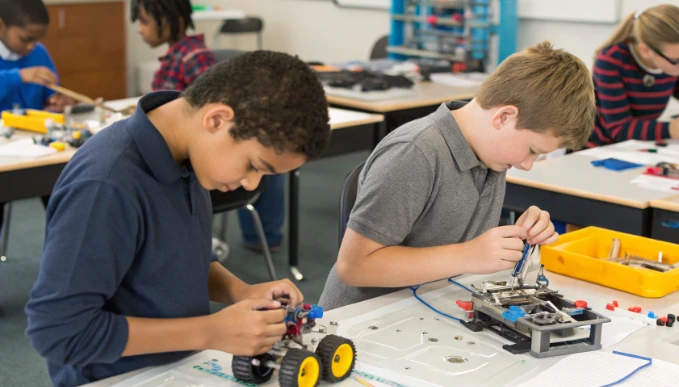
Practical takeaway for coordinators and educators: the curriculum’s effectiveness depends on three operational conditions — water testing access, sufficient time blocks (typically 25–30 hours for a standard deployment), and instructors prepared to facilitate iteration rather than provide solutions. The reported outcomes around confidence-building and peer mentoring are consistent across deployments, but the gender recruitment challenge is real and requires deliberate strategy. Verify these conditions honestly before committing to materials and licenses.

Who the Program Reaches and What the Data Shows
Across the deployments studied as part of the NSF scale-up grant, approximately 1,500 students provided data points the research team analyzed. The breakdown is informative for anyone trying to gauge fit:
- 53% of participants were girls, 47% boys. This near-balance is notable in robotics, where female participation has historically been substantially lower.
- 51% participated in informal settings (summer camps, after-school programs, community partnerships), and 49% in formal classroom settings. The near-even split confirms the curriculum’s flexibility across deployment contexts.
- The program serves students aged 12–18 (grades 7–12), with modified versions used for upper elementary and undergraduate engineering students.
The curriculum has been shown in NSF-funded research to be engaging for both girls and boys, and suitable for students ranging from special education to gifted and talented. This range matters: most STEM curricula work well at one end of the ability spectrum and underperform at the other.
The Four Learning Goals That Drive the Design
Every design choice in the WaterBotics curriculum traces back to four explicit outcomes. The program is built to produce students who:
Learn
Learn, experience, and apply the practices of engineering design.
Understand
Develop increased understanding of core disciplinary ideas in physical science, engineering, and information technology.
Collaborate
Gain 21st century skills — problem-solving, teamwork, innovation, and creativity.
Connect
Develop increased awareness of and interest in engineering and IT careers.
The structure of the curriculum — the mission-based progression, the iterative testing requirements, the showcase event format — exists to deliver these specific outcomes. Understanding this matters because it explains why the curriculum doesn’t compress well: removing iteration cycles to save time directly undercuts outcomes 1 and 3.
The Mission-Based Structure That Drives Learning
The curriculum is organized into four scaffolded missions that gradually increase in complexity. Each mission is framed as a real-world application of underwater remotely operated vehicles (ROVs), which gives students concrete connections to engineering work:
| Mission | Real-World Frame | Engineering Capability Added |
|---|---|---|
| 1. Rescue a Drowning Swimmer | Sea rescue robot | Single-motor, surface-level back-and-forth movement |
| 2. Clean Up a Pollution Spill | Environmental cleanup | Two-motor steering, two-dimensional surface movement |
| 3. Minesweep — Disable Underwater Mines | Naval mine clearance | Three-motor diving, three-dimensional underwater control |
| 4. Salvage a Shipwreck | Underwater archaeology | Fourth motor for grabbing and releasing objects |
Each mission ends with a showcase event rather than a competition. Students demonstrate their robots, describe their design goals, list the achievements they completed, identify areas for improvement, and receive feedback from peers. This format is deliberate — it focuses students on learning rather than ranking, and it tends to engage students who self-select out of competitive robotics structures.
Within each mission, students can pursue specific “achievements” — concrete sub-goals like rescuing a target within 10 seconds or rescuing 10 or more “swimmers” in one trip. This achievement system serves a practical purpose: it gives faster teams additional challenges so they don’t sit idle, and it lets slower teams succeed at the base mission without comparison pressure.
Why the Underwater Environment Matters Pedagogically
Building robots that work underwater forces students to engage with physical engineering trade-offs that land-based robotics doesn’t require. To produce a fully functioning underwater robot with six degrees of freedom, students must understand:
- Buoyancy — how the robot stays at a target depth without active control.
- Stability — keeping the robot upright when submerged.
- Drag — how water resistance affects propulsion and maneuverability.
- Mass, volume, and density — how the physical properties of materials affect performance.
- Action/reaction forces — how propellers generate movement.
- Torque — how motor power translates into thrust.
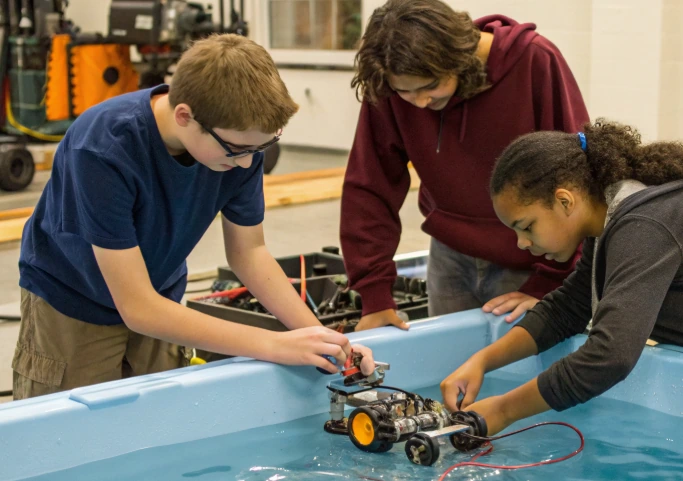
These concepts can’t be faked through clever programming. A robot with poor ballasting will list to one side or sink uncontrollably regardless of how well the control code works. Water provides immediate, unambiguous feedback — which is what makes it such an effective teaching environment.
The underwater context also levels the playing field for mixed-experience groups. Students who arrive with prior robotics experience often have it from land-based platforms, where the rules don’t fully apply underwater. This gives newcomers a more comparable starting point and reduces the dynamic where experienced students dominate teams.
NGSS Alignment That Goes Beyond Cosmetic Compliance
The curriculum aligns with the Next Generation Science Standards in ways that hold up to scrutiny rather than just appearing on a compliance checklist. The alignment covers three categories of standards:
Science and engineering practices
Science and engineering practices include asking questions and defining problems, developing and using models, planning and carrying out investigations, analyzing and interpreting data, constructing explanations and designing solutions, and engaging in argument from evidence. These map directly onto what teams do during mission iteration.
Disciplinary core ideas
Disciplinary core ideas include forces and motion (PS2.A) — where propulsion, drag, buoyancy, and gravity combine to produce the robot’s motion — and stability in physical systems (PS2.C), where the robot’s orientation must remain controllable when submerged. The engineering standards covered include defining and delimiting engineering problems (ETS1.A), developing possible solutions (ETS1.B), and optimizing design solutions (ETS1.C).
Crosscutting concepts
Crosscutting concepts include patterns (which gear combinations produce better propulsion), cause and effect (how design changes affect performance), systems and system models (robots as experimental models for testing motion laws), structure and function (how shape and mass affect motion), and stability and change (what makes a robot stable underwater).
For schools needing to justify the program against state curriculum requirements, this depth of alignment matters. The engineering design process at the core of WaterBotics maps onto most modern science standards beyond NGSS as well.
Why the LEGO Platform Was Chosen
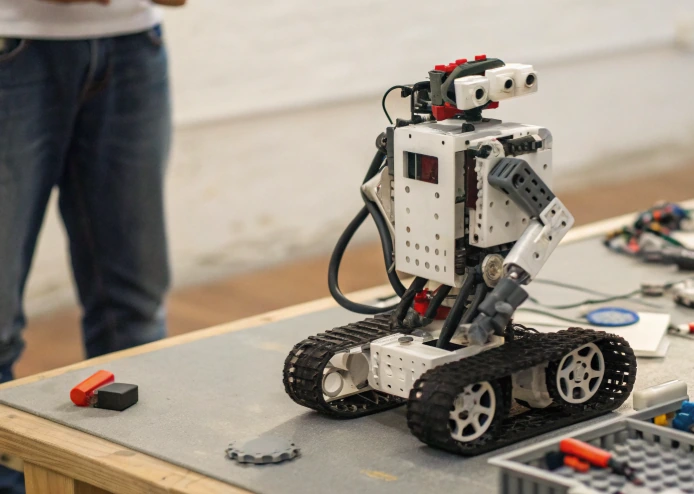
The choice of LEGO MINDSTORMS components as the structural and programming platform is a pedagogical decision rather than a cost decision. Custom-machined parts would produce more elegant robots — and would also kill the iteration loop that defines the curriculum.
LEGO components allow teams to assemble, test, disassemble, and reassemble in minutes. A robot that fails its first water test can be rebuilt and retested before the end of the same session. This rapid prototyping cycle is where the engineering design learning actually happens. Students who would lose momentum waiting two weeks for replacement custom parts can iterate three or four times in a single day on LEGO.
The MINDSTORMS programming environment (NXT-G icon-based programming in the original deployments) lets beginners learn coding through visual drag-and-drop logic rather than text-based syntax. This lowers the entry barrier without sacrificing what the program teaches — students learn loops, switches, data types, flow charts, and troubleshooting through the icon system.
What Real Deployments Look Like
The CIESE research documented case studies across formal and informal settings. The patterns are consistent enough to draw practical conclusions:
Formal classrooms
In formal classroom deployments, the curriculum integrates into pre-engineering programs, applied science electives, and middle school science fairs. Educators report that mixed-ability student groups work effectively because the underwater context creates novel problems no one has fully mastered before. The most consistent challenge mentioned is space — finding a pool or large tank for testing, which requires creative solutions in schools without aquatic facilities.
Informal settings
In informal settings like Girl Scout camps and museum programs, the curriculum runs as week-long intensives with morning sessions on robotics and afternoon field trips, industry visits, or related STEM activities. Single-gender camps in Girl Scout contexts produce particularly strong confidence-building outcomes — girls who arrive intimidated by programming consistently leave reporting it was less difficult than they expected.
Three themes appear across virtually all documented deployments:
- Confidence-building and persistence development are the most reported outcomes by educators. Students who complete the curriculum demonstrate measurably greater willingness to attempt difficult problems.
- Peer teaching emerges organically. Students who master specific tasks routinely teach struggling peers without being assigned to do so. Several camp organizers have brought back former participants as mentors for subsequent cohorts.
- Parental perception is a significant recruitment barrier for girls. Despite high engagement once girls enroll, parents often resist sending daughters to robotics camps. Interventions targeting parental attitudes appear necessary for closing the diversity gap further.
What to Verify Before Committing to a Deployment
For coordinators evaluating WaterBotics seriously, the practical checks worth running before commitment:
- Confirm pool, tank, or water access. This is the single biggest operational constraint and worth resolving first.
- Choose your time block honestly. A standard deployment runs approximately 25–30 hours of contact time. Fragmenting this across many short sessions weakens outcomes substantially.
- Budget for kit replacement parts and curriculum licensing. Initial kit costs are only part of the picture — ongoing wear and the curriculum license are recurring expenses.
- Plan instructor preparation. Facilitators need to coach iteration without solving problems. CIESE has historically offered professional development — check current availability.
- Build a recruitment strategy that reaches girls. Open enrollment alone will produce the gender imbalance the research documented in parental perceptions. Active outreach through trusted networks works better.
The right next step is contacting CIESE at Stevens Institute of Technology directly for current equipment requirements, licensing terms, and available training. The curriculum’s underlying research base — published with NSF support and citable through the original Holahan et al. (2015) paper — makes it one of the better-documented STEM programs available for serious evaluation.